
Termites
Termite Control
Silverfish Control Melbourne | Roof Voids, Wardrobes and Storage
Silverfish in the wardrobe or bookshelf? We treat the roof void and storage areas across Melbourne where they breed. Call 0435 073 966 for a free quote.
Tell us what you have seen
Silverfish are slow to build and easy to underestimate. Tell us where you are seeing them and what has been damaged, and we will tell you where the population is living.
Request a callback
Choose your service, add a few details, and we will call you back with a quote. Open 24 hours — we answer after hours.
You see them in the bathroom. They live in the roof.
Silverfish need humidity and darkness and they eat starch — paper, book bindings, wallpaper paste, photographs, natural fabrics, cardboard and the starch in stored linen. The ones you find stranded in a bath or basin have wandered in and cannot climb back out. The population itself is usually in the roof void, the wall cavity or the back of a built-in wardrobe.
That is why a can of surface spray in the bathroom does nothing. Treating silverfish properly means getting a residual dust or spray into the roof void and the wardrobe and storage voids where they are actually breeding, and dealing with the damp that made the place attractive in the first place.
The damp subfloor that suits silverfish suits other things too. While we are under the house we check the bearers and joists for borer, because the same blocked vents that let humidity build are what keeps timber pests active — and finding it early is the difference between a treatment and a repair.
What silverfish leave behind
The damage is usually noticed before the insect is.
The insect
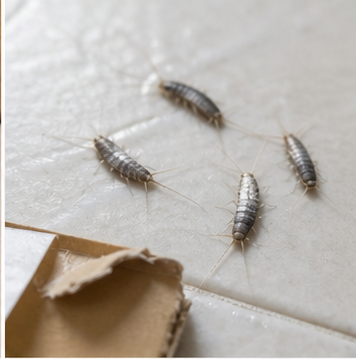
- Silver-grey, carrot-shaped insects 10–15 mm long with three tail filaments
- Fast, wriggling movement that looks like a small fish
- Insects stranded in a bath, basin or sink in the morning
- Activity at night when a light is switched on
- Yellowish stains and tiny scales left on surfaces
- Numbers rising through a humid Melbourne summer
The damage
- Irregular holes and grazed surfaces on paper and book pages
- Damage to wallpaper, especially along the paste seams
- Small holes in stored cotton, linen and silk
- Damaged photographs, certificates and stored documents
- Grazing on cardboard boxes in the garage or roof space
- Fine, powdery residue in the bottom of a wardrobe
Silverfish thrive above about 75% humidity. Poor subfloor ventilation, an unflued heater, a bathroom without an exhaust fan or a leaking gutter is very often the underlying cause.
Silverfish can live for years and take months to mature. A heavy population means a long-established one, and it also means treatment results build over weeks.
Stored boxes, book shelves, linen presses and the roof void are where the population lives. The bathroom is just where they get stuck.
Why they are in your roof and not your bathroom
Six things about this insect that decide where it lives, how fast it builds and why treatment takes weeks rather than days.
Starch and polysaccharides — book bindings, wallpaper paste, photographs, the sizing in paper, cardboard, and natural fibres like cotton, linen, silk and rayon. They will not touch polyester or nylon. That is why a wool-blend garment is grazed and its synthetic lining is untouched, and it is often the clue that tells us it was silverfish and not a moth.
Silverfish thrive between about 75% and 95% relative humidity and struggle below roughly 55%. In Melbourne the usual cause is a subfloor vent blocked by a raised garden bed, paving or mulch. Clearing the vents does more for a long-term result than any product, and it is why we look under the house on a silverfish job.
A female lays around sixty eggs in her whole life, and in a cool Melbourne roof void a nymph can take up to three years to reach maturity. That cuts both ways: a heavy population means a long-established one, and treatment results build over three to six weeks rather than appearing overnight.
Two to eight years is normal, and unusually for an insect they continue moulting as adults — up to sixty times. The pale, papery shed skins collecting in the base of a wardrobe are frequently the first thing a homeowner notices, before any live insect is seen.
A silverfish can survive close to a year without food. Emptying a cupboard and leaving it empty achieves very little — they simply wait, or move to the next room. The population has to be treated where it harbours, which is why the roof void matters more than the cupboard.
Silverfish graze the surface, leaving irregular etched patches and scalloped edges. A clothes moth punches clean holes right through the fabric. If you are looking at surface scraping on paper or the nap taken off a fabric, it is silverfish; if you are looking through a hole, it is not.
The pests that quietly eat your belongings
None of these will hurt you. All three ruin things you cannot replace — paper, photographs, wool and timber — and all three are found in the same dark, still, slightly damp parts of a house.


Two things worth knowing
Silverfish are a slow pest and the treatment behaves accordingly.
This is not an overnight result
Silverfish are long-lived and slow-breeding, and they do not forage the way ants or cockroaches do. A residual treatment works as individuals move across treated surfaces, which takes weeks rather than days.
You should see numbers fall steadily over three to six weeks. If someone promises an immediate result, they are describing a different insect.
The treatment lasts as long as the humidity allows
Silverfish are a symptom as much as a pest. Blocked subfloor vents, a bathroom with no working exhaust fan, a leaking gutter discharging against the wall, or stored cardboard in a damp garage will keep producing them.
We will tell you which of those applies to your property. Fixing it is usually cheap and it is the difference between one treatment and an annual one.
Our four-step silverfish treatment
Straightforward, provided it reaches the right voids.
Inspection
We find where the population actually lives — roof void, wall cavities, wardrobes, linen press and storage.
Roof void treatment
A residual dust is applied through the roof void, which is where most Melbourne silverfish populations are based.
Interior treatment
Wardrobes, shelving, skirtings, storage areas and cupboard voids are treated with a long-residual product.
Moisture advice
We identify the ventilation or damp problem that made the property attractive, so the result holds.
What silverfish treatment costs
Every price is a from price — it depends on the property size and how many storage areas and voids need treating. You get the figure in writing before we start.
Targeted treatment
Treatment of the affected rooms, wardrobes and storage.
Full property treatment
Roof void dusting plus interior treatment of all wardrobes, storage and skirtings. The usual choice.
Large or heavily infested
Larger homes, extensive storage, or properties needing a follow-up visit.
Clear written quotes.We beat any written quote by 5%. Commercial, strata and end-of-lease jobs are quoted on inspection.
Free re-treatment inside the warranty period
If the pest comes back inside the warranty period on a treated property, we return and re-treat at no charge. The warranty follows the treatment, not the visit — an inspection on its own cannot be warranted, and we would rather say that plainly than sell you a guarantee that quietly excludes you.
What silverfish actually damage
They will not hurt you. They will quietly ruin things you cannot replace.
Documents and photos
Certificates, photographs and stored paperwork are prime targets, and the damage is not reversible.
Books
Bindings, page edges and the glue in spines are all food. Collections stored in a roof space are especially vulnerable.
Clothing and linen
Natural fibres and the starch in stored linen are grazed, leaving small irregular holes.
Wallpaper
Paste seams are attacked from behind, which is why the damage often appears as lifting rather than obvious holes.
Silverfish Control questions we get asked
If yours is not here, call 0435 073 966 — we will answer it on the phone without booking you in first.
Call 0435 073 966How much does silverfish treatment cost in Melbourne?
Targeted treatment starts from $129, a full property treatment including roof void dusting from $169, and larger or heavily infested properties from $229. You get the figure in writing before we start, and we beat any written quote by 5%.
Why do I only see them in the bathroom?
Because they wander in and cannot climb back out of a bath or basin. The population itself is almost always in the roof void, a wall cavity or the back of a built-in wardrobe — which is why treating only the bathroom achieves nothing.
How long until they are gone?
Expect numbers to fall steadily over three to six weeks. Silverfish are long-lived and slow-breeding and they do not forage like ants, so the residual treatment works as individuals cross treated surfaces. Anyone promising an overnight result is describing a different insect.
Are silverfish harmful?
Not to people — they do not bite, sting or transmit disease. The damage is to property: books, documents, photographs, wallpaper, stored linen and natural fabrics.
Why do I have them?
Humidity. Silverfish thrive in damp, dark conditions, so blocked subfloor vents, a bathroom without a working exhaust fan, a leaking gutter against a wall or cardboard stored in a damp garage are the usual causes. We will tell you which applies to your property.
Will they come back?
Not if the moisture issue is addressed. If the underlying humidity stays, the population will slowly rebuild — which is why we point out the specific ventilation or damp problem rather than just treating and leaving.
Do you treat the roof void?
Yes, and on most Melbourne properties that is the important part. A residual dust through the roof void reaches the population where it actually lives.
Is the treatment safe around books and clothing?
Yes. We treat the voids, shelving edges, skirtings and cupboard interiors rather than spraying over your possessions, and we will tell you what to move before we start.
Should I throw out damaged items?
Not necessarily, but do get valuable documents and photographs into sealed containers. Stored cardboard is both food and harbourage, so replacing cardboard boxes with sealed plastic tubs is one of the more effective things you can do yourself.
Other services that often come up with this one
Silverfish in the wardrobe?
We answer 24 hours a day and we can usually be there the same day.
Get your free quote
Tell us what you have seen or heard. We will call you back with a quote before any work starts.