
Termites
Termite Control
Rodent Removal Melbourne | Rat and Mice Control
Hearing scratching in the roof at night? We remove rats and mice across Melbourne the same day, then seal the gaps. Call 0435 073 966 for a free quote.
Tell us what you have heard
Most people call us because of a noise, a smell or a droppings trail. Describe what you have noticed and we will tell you what is likely causing it and what it costs to fix.
Request a callback
Choose your service, add a few details, and we will call you back with a quote. Open 24 hours — we answer after hours.
One rodent problem, three different animals
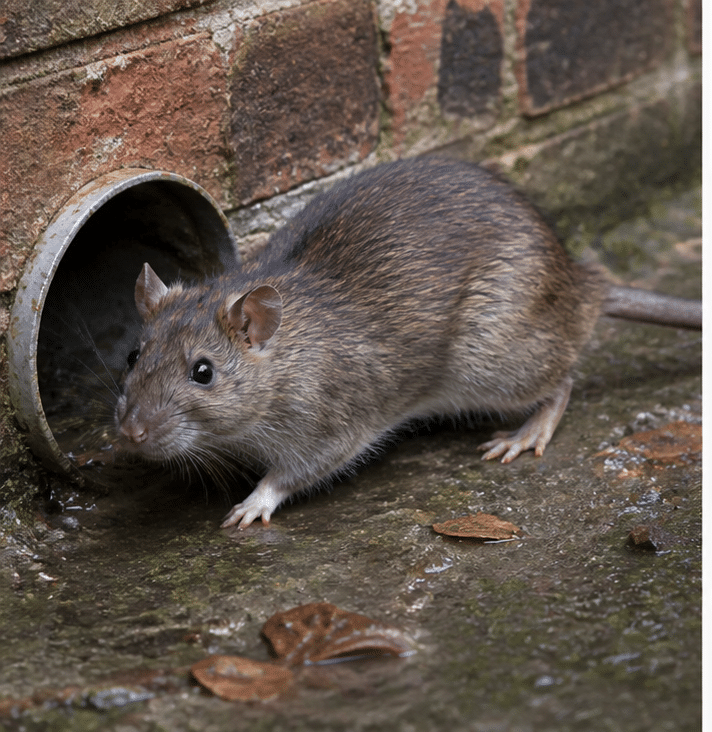
Melbourne has three rodents that live in buildings, and they behave so differently that treating them the same way is the single most common reason a DIY attempt fails. A roof rat lives above you and travels along beams and cables. A Norway rat lives below you, in the subfloor, the drains and the garden. A house mouse does not need to travel at all, because it will happily nest inside the wall cavity of the room you are standing in.
Our technicians identify which one you have before anything is placed, because the identification decides where the stations go, how many are needed, and which entry points actually matter. That is the difference between rodent control that holds and a treatment you repeat every spring.
How to tell a rat problem from a mouse problem
You can usually settle this yourself in about two minutes, and it is worth doing before you call anyone — including us. Every competitor describes the two animals. None of them give you a way to decide.
| What you found | Points to a rat | Points to a mouse | What it means |
|---|---|---|---|
| Droppings | 15–20 mm, blunt ends, scattered along runs | 3–7 mm, pointed ends, often in one concentrated spot | Measure one. It is the fastest reliable tell. |
| Sound | Heavy, deliberate thumps; you can follow the path | Light, fast scurrying and scratching, often in a wall | Rats sound like something walking. Mice sound like something running. |
| Where | Roof void, subfloor, wall cavity, drains, compost | Kitchen cavities, pantry, appliance housings, insulation | Rats commute. Mice nest within about 5 m of food. |
| Damage | Gnawed timber, chewed cable insulation, burrows | Shredded paper and fabric, small clean 20 mm holes | A 20 mm hole is a mouse. A 40 mm hole is a rat. |
| Numbers | A few, breeding slowly, cautious of new objects | Many, breeding fast, curious about new objects | One mouse is rarely one mouse for long. |
| Treatment | Fewer stations, placed on travel routes, patient | More stations, placed close together, fast turnover | Wrong species means wrong placement means no result. |
The three rodents that live in Melbourne buildings
Identification is not trivia. It decides where the stations go and which gaps have to close.
Norway rat (brown or sewer rat)
The big one. Up to 500 g, blunt nose, small ears, a tail shorter than its body. It burrows rather than climbs, so in Melbourne it turns up in subfloors, along fence lines, under decking and in compost bays, and it moves indoors when the weather turns. It is neophobic — genuinely suspicious of anything new — which is why a station dropped in yesterday can sit untouched for a week and look like a failure when it is simply working slowly.
Roof rat (black or ship rat)
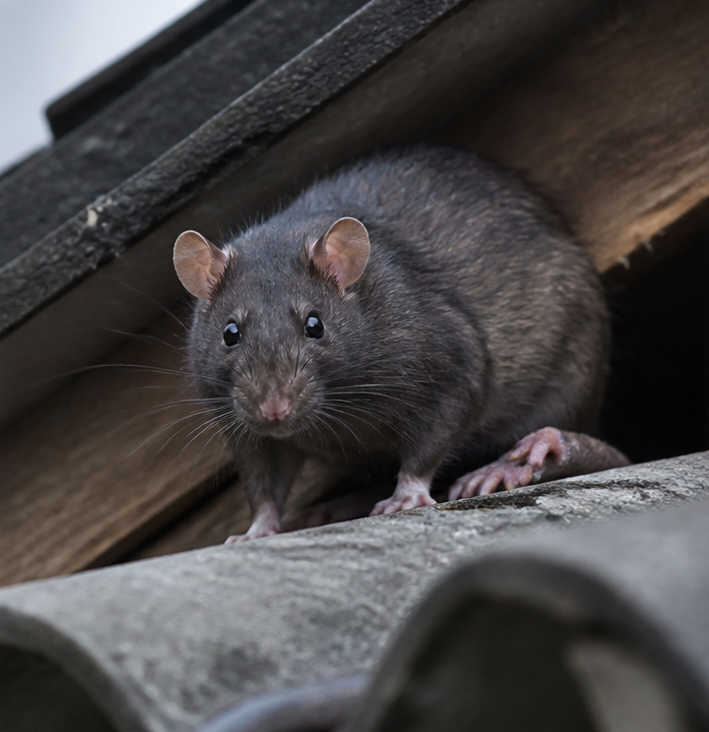
The common one in inner-Melbourne roof voids. Lighter at around 200 g, pointed nose, large thin ears, and a tail longer than its body. It is an exceptional climber and uses overhanging branches, downpipes and power lines as a road network, which is why sealing a roof without cutting back the tree that touches it rarely holds. This is the animal behind most ‘something is running above the ceiling at 2am’ calls.
House mouse
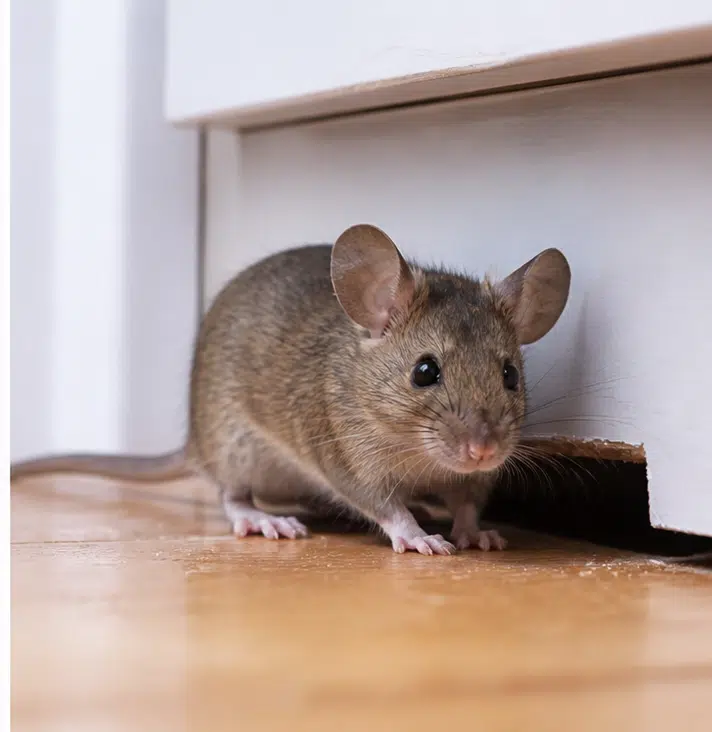
Small, grey-brown, with a pointed snout and ears that look too big for its head. A house mouse needs a gap the width of a pencil, breeds from about six weeks old, and produces up to ten litters a year. Unlike rats it is curious about new objects, so it finds stations quickly — but it also nests within a few metres of food, which means the treatment has to reach inside cabinetry and appliance housings, not just the perimeter.
What you have probably noticed already
Rodents are nocturnal and cautious, so most people hear or smell them long before they see one. If two or more of these apply, you have an active problem rather than a one-off visitor.
What you can see
- Droppings along a skirting board, beam or the top of a wall plate
- Dark greasy smear marks where fur repeatedly brushes a fixed edge
- Gnaw marks on timber, plastic pipe or cable insulation
- Shredded insulation, paper or fabric pulled into a nest
- A sharp stale ammonia smell in an enclosed roof or cupboard
- Pet suddenly fixated on one spot of wall or ceiling
What you can hear or smell
- Scratching or scurrying overhead between dusk and about 2am
- A rolling or dragging sound as food is moved along a run
- Sudden silence when you knock the ceiling, then movement again
- Gnawing that stops and starts in the same wall each night
- Thumps heavy enough to sound like something the size of a possum
- Noise that tracks from one end of the house to the other
Roof rats leave the nest to forage shortly after dark. Activity that starts at sunset and stops before dawn is the classic pattern.
A repeated location means a nest, not a passing animal. It also tells us where to open up and where the entry point will be.
Rodents seen in daylight usually mean the population has outgrown its harbourage. That is a same-day call, not a next-week one.
Three things most rodent control pages will not tell you
We would rather you knew these before you booked, with us or with anyone else.
Bait without proofing is a subscription, not a fix
Bait kills the rodents that are inside your building today. It does nothing whatsoever to the gap they used to get in. A property with an open weep hole, a perished door seal or a 30 mm gap where the pipe enters the wall will be re-colonised, because the resource that attracted the first one has not changed.
This is why we quote proofing as part of the job rather than as an upsell, and why our warranty covers proofed properties. If someone quotes you a rodent treatment without ever going into the subfloor or onto the roof, they are selling you next season’s callout as well.
Secondary poisoning is real, and it is your choice
Second-generation anticoagulant baits stay in a rodent’s body after death. A dog that eats a poisoned rat, or a powerful owl or tawny frogmouth that takes one, can be poisoned in turn. Melbourne has a genuine urban owl population, and this is a documented problem, not a scare story.
So we keep bait in locked tamper-resistant stations, we log every placement and recover what is left at the end of the job, and where you have pets, chooks or strong feelings about wildlife we will run the job on traps instead. Ask us — it changes the method, not the outcome.
A poisoned rodent can die inside your wall
Nobody advertises this. A rodent that takes bait may die anywhere, including in a wall cavity, under a bath or in the roof insulation, and a decomposing rat is a two to three week smell that no air freshener touches. It also draws flies and, in warm weather, maggots.
We reduce the odds by placing stations along external runs rather than deep inside the building envelope, and if it does happen we come back and locate it. Dead animal removal is a service we run in its own right, so you are not left ringing round for someone else.
What we do instead
Find the harbourage, confirm the species, place a station network sized to that species, then close the building. The proofing is the part that lasts: stainless mesh to weep holes and vents, brush or compression seals to door thresholds, sheeting to gaps around service penetrations, and cutting the roof off from the branches and cables that feed it.
Then we come back and check. A rodent job that is never revisited is a guess.
Our four-step rodent treatment
Same on a one-bedroom flat in Carlton as on a warehouse in Dandenong — the scale changes, the sequence does not.
Inspection
We inspect the interior, roof void, subfloor and external perimeter, identify the species and find the entry points. You get the findings and the price before anything is placed.
Treatment
Tamper-resistant stations or traps are placed on the actual travel routes, keyed, numbered and logged. Placement is chosen for the species we confirmed, not from a template.
Proofing
The gaps that let them in are closed with mesh, seals and sheeting. This is the step that decides whether the problem returns, and it is why the warranty is tied to it.
Follow-up
We return to check consumption, recover unused bait, remove what has died where we can reach it, and confirm the activity has stopped.
What rodent control actually costs
Melbourne rodent work generally runs between $150 and $400, and almost nobody publishes a number. Here is ours. Every price is a from price — the final figure depends on the size of the property, how far the infestation has gone and how much proofing the building needs, and you get that figure in writing before we start.
Inspection
Full property inspection, species identification, entry-point report with photos. Credited against the treatment if you book on the day.
Treatment
Inspection plus a full station or trap network, placement log, and one follow-up visit. The usual choice for a house with an active problem.
Treatment + proofing
Everything above plus the physical proofing work — mesh, seals and sheeting — and the 12-month written proofing warranty.
Clear written quotes.We beat any written quote by 5%. Commercial, strata and end-of-lease jobs are quoted on inspection.
12-month written proofing warranty
If rodents get back in through a gap we sealed, we come back and fix it at no charge for twelve months. The warranty covers proofed properties — a treatment-only visit cannot be warranted, because the building is still open. We would rather say that plainly than sell you a guarantee that quietly excludes you.
What an untreated rodent problem costs you
This is not about alarm. It is about the fact that rodent damage compounds quietly and is usually not covered.
Fire
Rodents gnaw cable insulation to keep their incisors worn down. Chewed wiring in a roof void is a recognised ignition risk and one of the more expensive reasons to act early.
Contamination
Droppings and urine contaminate stored food, benchtops and cutlery drawers. Mice in particular urinate more or less continuously as they move.
Disease
Rodents are associated with leptospirosis, salmonella, rat-bite fever and murine typhus. Transmission is uncommon in Melbourne but the contamination risk is not.
Insurance
Rodent damage is frequently excluded from home policies as a maintenance issue, which means chewed wiring, ruined insulation and soiled ceiling batts land on you.
The Melbourne rodent year
If you only proof once, do it in late summer — before the autumn move indoors, not during it.
Breeding season. Populations built over winter start expanding and you notice noise you did not have in July.
Rodents move outdoors and towards water. Compost, pet bowls and fallen fruit do most of the recruiting.
The big one. As nights cool, rats and mice push indoors looking for harbourage. Most Melbourne roof-rat calls start here.
They are already inside and settled. Activity is quieter but damage continues, and this is when proofing pays.
Cafés, kitchens, warehouses and strata
A rodent sighting in a food business is not a pest problem, it is a trading problem. We work to a documented station map with numbered, keyed stations and a service record you can hand straight to an auditor or an environmental health officer, and we schedule visits outside your trading hours.
For strata and property managers, the report names the entry points and the common-property defects behind them, which is usually what the owners corporation actually needs in order to approve the repair. We service kitchens, cafés, restaurants, aged care, childcare, warehousing and retail across Melbourne.
After-hours and emergency attendance is available 24/7.
Need a service record for an audit?
Tell us what you are being asked to produce and we will set the program up to match it — station map, placement log, visit history and recommendations.
Call 0435 073 966Rodent control questions we get asked
If yours is not here, call 0435 073 966 — we will answer it on the phone without booking you in first.
Call 0435 073 966How much does rodent control cost in Melbourne?
Melbourne rodent treatments generally run between $150 and $400 for a standard home. Our inspections start from $129, treatment from $179, and treatment with full proofing from $449. The final price depends on property size, how established the infestation is and how much physical proofing is needed — you get it in writing before we start, and we beat any written quote by 5%.
How quickly can you come out?
We offer same-day appointments across metropolitan Melbourne and we answer the phone 24/7. Daytime sightings, a rodent in a food business, or noise directly above a child’s bedroom are the ones we prioritise.
How long does it take to get rid of rats or mice?
Mice usually resolve within one to two weeks because they find stations quickly. Rats take longer — often two to four weeks — because they are suspicious of new objects and will ignore a station for several days before touching it. Slow early consumption is normal and is not a sign the treatment has failed.
Is the treatment safe around pets and children?
Bait is only ever used inside locked, tamper-resistant stations that a child or a dog cannot open, and every placement is logged and recovered at the end of the job. If you have pets, chickens, or you would rather no anticoagulant was used at all, say so and we will run the job on traps instead.
Can a poisoned rat die inside my wall?
It can. A rodent that takes bait may die anywhere it happens to be, and a carcass in a wall cavity or roof void produces a strong smell for roughly two to three weeks. We reduce the risk by favouring external placements, and if it happens we return to locate and remove it — dead animal removal is a service we run in its own right.
Will baiting on its own solve the problem?
No. Baiting clears the rodents that are inside now; it does not close the gap they used to get in, so the property is simply re-colonised. Proofing — mesh, seals and sheeting over the actual entry points — is the part that makes the result last, which is why our warranty applies to proofed properties.
Do I have a rat or a mouse?
Measure a dropping. Rat droppings are 15–20 mm with blunt ends; mouse droppings are 3–7 mm with pointed ends. Sound helps too — rats sound like something walking above the ceiling, mice sound like something running inside a wall. There is a full comparison table further up this page.
Why do I only hear them at night?
Rats and mice are nocturnal and avoid open space. Roof rats typically leave the nest shortly after dark and return before dawn, which is why the noise starts at dusk and stops by about 2am. Hearing them in daylight usually means the population has outgrown its harbourage.
Do ultrasonic rodent repellers work?
No. There is no good evidence that plug-in ultrasonic devices produce lasting rodent control, and rodents habituate to the sound quickly. We would rather tell you that than let you spend another month on one.
I rent. Who is responsible?
In Victoria, rodent proofing and structural defects are generally the rental provider’s responsibility, while ongoing hygiene is the renter’s. In practice, report it in writing to the agent and ask for a pest inspection. We are happy to provide a report that identifies the building defects behind the problem.
Do you treat commercial kitchens and food businesses?
Yes. We run documented programs with numbered, keyed stations, a station map and a service history suitable for an auditor or environmental health officer, scheduled outside trading hours.
What areas do you cover?
All of metropolitan Melbourne, including the inner north and east, the bayside suburbs, the western and south-eastern growth corridors and the outer fringe. If you are not sure whether you are in range, call and ask.
Will you come back if they return?
Proofed properties carry a 12-month written proofing warranty — if rodents get back through a gap we sealed, we return and fix it at no charge. A treatment-only visit cannot carry that warranty, because the building has not been closed.
Something in the roof tonight?
We answer 24 hours a day and we can usually be there the same day.
Get your free quote
Tell us what you have seen or heard. We will call you back with a quote before any work starts.